

The Volume War
The TV volume war
Somebody in the house needs it loud. Somebody else keeps reaching for the remote. Here's why you're both right, and what actually settles it.
Turning it up was never going to work
The argument feels like a disagreement about volume. It isn't. It's a disagreement about which sounds matter, and the remote can't tell the difference between them.
Modern soundtracks are mixed so that dialogue sits in the same layer as the score, the effects and the room ambience. Turn up the volume and all of it rises together — the words get louder, but so does everything burying them. Meanwhile flat-panel TVs have no room inside for real speakers, so most fire their sound backwards or downwards into a wall, which smears speech before it ever reaches you.
The part that carries meaning is the consonants: the s, t and f sounds that separate "he can't stay" from "he can stay." They're quiet, high-frequency, and the first thing to go — both in a compressed stream and in an ear that's been listening for sixty years. No amount of volume puts them back.

AccuVoice AV855 Soundbar
Twenty levels of voice boost, so you can find the exact setting where nobody complains.
The most capable bar ZVOX makes for a normal living room. Twenty levels of dialogue boost is the number that matters here — it means the adjustment is a dial rather than a switch, so you can creep up one step at a time until both of you stop noticing, then leave it there permanently. Dual built-in subwoofers keep music and effects full instead of thin and tinny, HDMI-ARC means your existing TV remote handles volume and power, and Output Leveling automatically pulls down commercials that come in hot.
- 20 levels of AccuVoice dialogue boost
- Dual built-in subwoofers
- HDMI-ARC — works with your TV remote
- Output Leveling tames loud commercials
- Recommended for TVs over 50 inches
AccuVoice makes TV dialogue easier to understand without cranking the volume.
CNET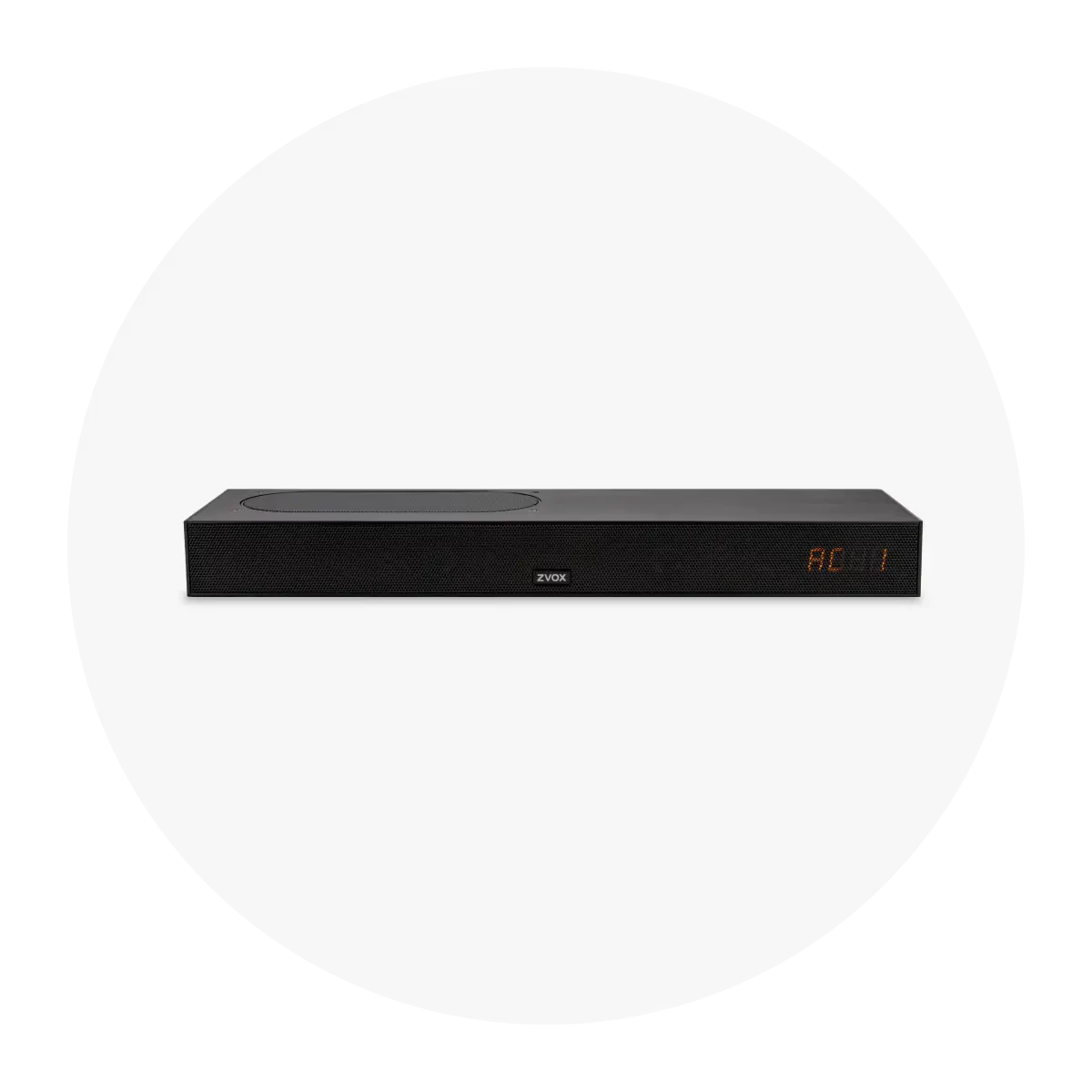
AccuVoice AV835 Soundbar
The same twenty levels of control, in a smaller cabinet for a hundred dollars less.
Identical dialogue adjustment to the AV855 — the full twenty steps — with two woofers in place of dual subwoofers and a footprint scaled for a smaller set. It still connects over HDMI-ARC, so it's one cable and no second remote to lose. For a bedroom, a den, or any room where the TV isn't the biggest thing in it, this is the sensible one.
- 20 levels of AccuVoice dialogue boost
- Two built-in woofers
- HDMI-ARC — one cable, your TV remote
- PhaseCue virtual surround
- Recommended for TVs under 50 inches

SB500 Sound Bar
The biggest sound in the range, built to hang under a mounted screen.
A 43.9-inch bar with built-in subwoofers, designed to mount below the TV rather than sit in front of it. It has the most output ZVOX makes, which matters in a large or open-plan room where sound has somewhere to escape to. The trade-off is connection: optical and analog rather than HDMI, so you'll be using its own remote instead of your TV's. Output Leveling is included.
- 43.9-inch bar, built for wall mounting
- Built-in subwoofers
- Optical and analog inputs
- Output Leveling tames loud commercials
- Recommended for TVs over 50 inches
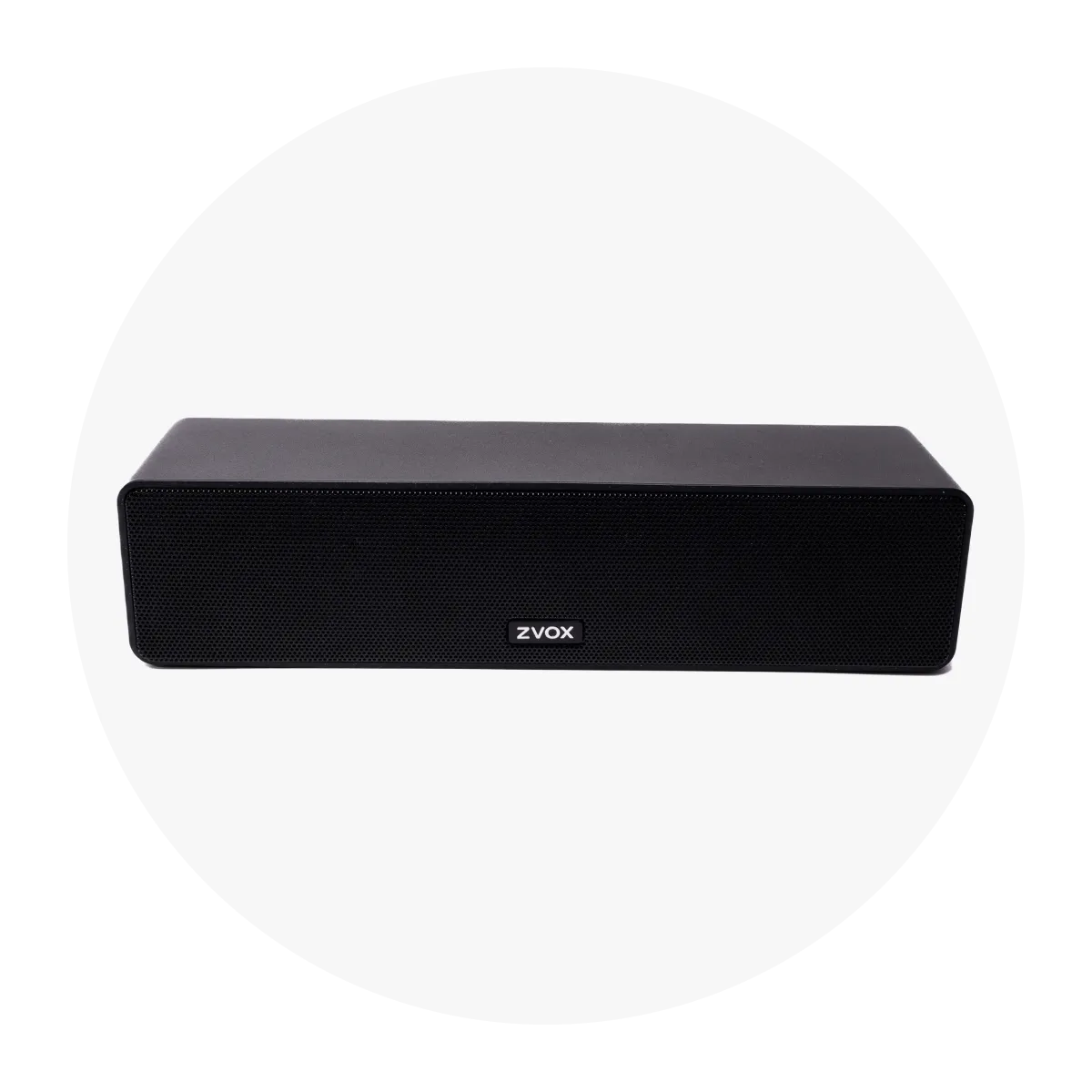
AccuVoice AV100 TV Speaker
A hundred dollars to find out whether this really is what you've been arguing about.
Six levels of AccuVoice boost, optical or analog in, and deliberately nothing else — no HDMI, no display, no surround processing. But the core idea is the same one, and the sixty-day home trial makes it a low-stakes experiment. If clearer consonants turn out to be the thing that ends the volume argument in your house, you'll know within a week, and you can trade up knowing why.
- 6 levels of AccuVoice dialogue boost
- Optical and analog inputs
- Compact — sits in front of the TV
- Recommended for TVs under 50 inches
Nobody has to win this one.
The volume war ends when the volume stops being the thing you're adjusting. Every speaker here does one job first — making voices easier to understand — and every one of them comes with sixty days at home to prove it in the room where the argument actually happens.
Compare every model